Follow us on Wechat

Current Issue

2026 Vol. 11, No. 5

RESEARCH ARTICLES
Fundamental Physics at Extreme Light
HotLoop optimization of petawatt laser focal spot via a twin-focus scheme
Qingfan Wu, Ying Gao, Minjian Wu, Jiarui Zhao, Shiyou Chen, Tianhao Liang, Haoran Chen, Tan Song, Zhongshuai Zhang, Zhangyi Wu, Shirui Xu, Ziyang Peng, Tianqi Xu, Zhuo Pan, Yujia Zhang, Qihang Han, Ke Chen, Chenghao Hua, Pengcheng Fan, Yuntian Xie, Yifei Shen, Shengxuan Xu, Liyong Ma, Yixing Geng, Chen Lin, Yanying Zhao, Xueqing Yan, Wenjun Ma
2026, 11(5) doi: 10.1063/5.0325110
Abstract:
Achieving diffraction-limited focusing of high-power laser pulses to generate ultrahigh intensities is crucial for developing compact laser-driven particle accelerators and exploring strong-field quantum electrodynamics. However, accurately diagnosing and optimizing the focal spots of petawatt (PW) laser pulses remains a significant challenge. In this work, we present an experimental methodology utilizing a twin-focus scheme to precisely characterize the intensity distribution and wavefront of focused PW femtosecond laser pulses, and employ it to elucidate their power-dependent evolution. Furthermore, we optimize the focal spots at full power via our in situ wavefront correction method called “HotLoop,” achieving a Strehl ratio of 0.80 for 1 PW laser pulses. Consequently, the cutoff proton energies in laser proton acceleration experiments are significantly enhanced. The success of this approach underscores the necessity of in situ high-energy wavefront correction for ultrahigh-intensity laser–matter interactions.
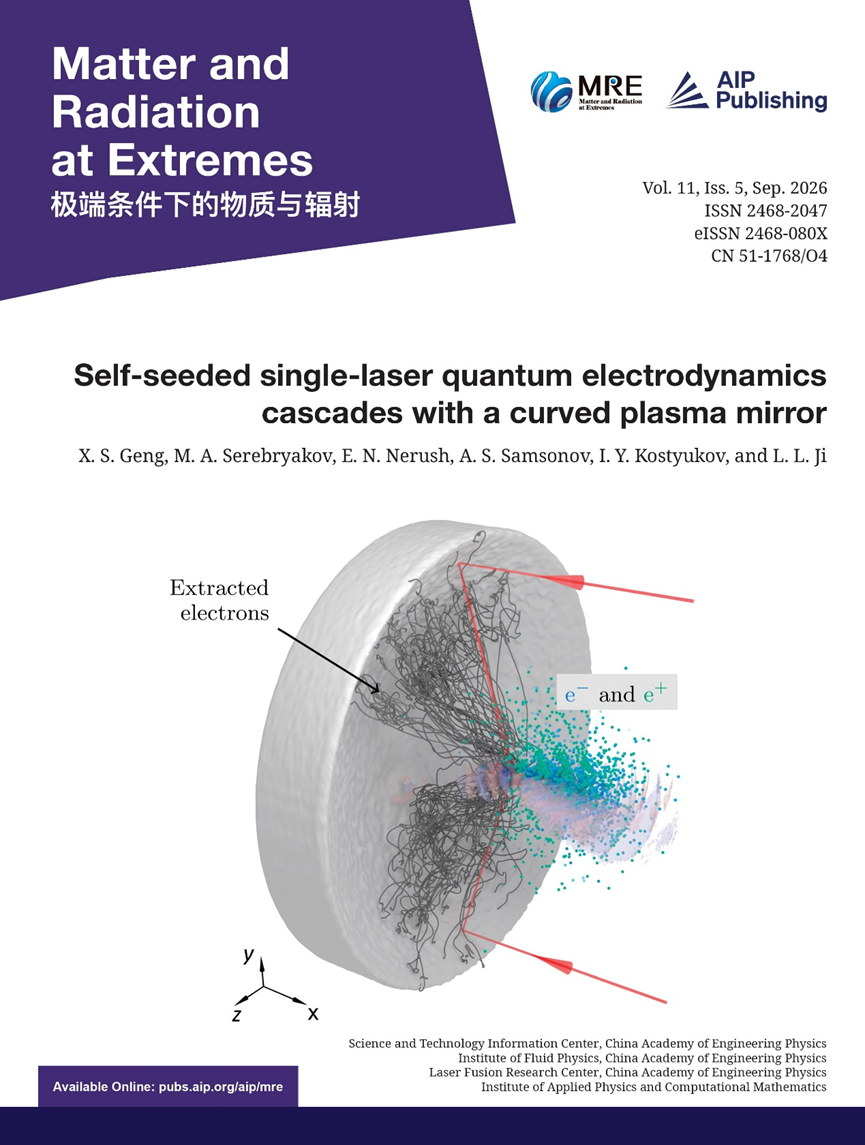
Self-seeded single-laser quantum electrodynamics cascades with a curved plasma mirror
X. S. Geng, M. A. Serebryakov, E. N. Nerush, A. S. Samsonov, I. Y. Kostyukov, L. L. Ji
2026, 11(5) doi: 10.1063/5.0296339
Abstract:
We demonstrate a self-seeded quantum electrodynamics (QED) cascade driven by a single 100 PW laser pulse reflected from a curved plasma mirror. Three-dimensional particle-in-cell simulations show that the reflected field self-injects electrons from the mirror surface and accelerates them toward the geometric focus, where the intensity reaches a0 ≈ 4000, triggering an avalanche-type cascade with more than seven generations. The generated pairs are accelerated within a propagating wave rather than a standing wave, producing 60 nC of pairs in collimated beams with high contrast to background electrons. The generated pair plasma exhibits collective behavior, absorbing the incident laser power and screening the laser field at high intensities. This single-beam geometry eliminates multipulse alignment requirements and provides a direct path to studying prolific light-to-matter conversion in strong-field QED.
Effects of shock on laser wakefield electron acceleration and betatron radiation
Eitan Y. Levine, Kim Ta Phuoc, Sheroy Tata, Tim Hager, Eyal Kroupp, Victor Malka
2026, 11(5) doi: 10.1063/5.0295843
Abstract:
Enhancement of betatron X-ray radiation produced in laser–plasma accelerators has previously been achieved by increasing the transverse oscillation amplitude of accelerated electrons in a tilted-shock traversal. This article reports on a simultaneous analysis of the properties of the betatron radiation and the trajectories of the relativistic electrons. The correlations of their parameters indicate new opportunities for improving betatron sources.
Positron collimation driven by channel fields excited by a Doppler-boosted laser pulse in the prefilled target
Yi-Nuo Liu, Zhang-Hu Hu, Wang-Wen Xu, Hao-Yuan Li, Jie-Jie Lan, You-Nian Wang
2026, 11(5) doi: 10.1063/5.0333168
Abstract:
We propose an all-optical configuration for the integrated generation, collimation, and acceleration of positrons with laser–electron beam interaction in a channel target. The electromagnetic fields driven by a Doppler-boosted laser within the channel yield a high-collimated dense positron bunch (with a peak density of ∼1028 m−3 and a duration of ∼27 fs). With the channel target, the beam divergence angle (FWHM) is decreased from 40° to 23°, and the monoenergetic peak is expected to upshift to hundreds of MeV. Moreover, automatic spatial and spectral separation between positrons and background electrons is also achieved, providing a promising scheme for future high-quality positron generation in compact integrated devices.
Radiation and Hydrodynamics
Unlocking the power of orbital-free density functional theory to explore the electronic structure under extreme conditions
Cheng Ma, Qiang Xu, Zhenhao Zhang, Ke Wang, Ying Sun, Wenhui Mi, Zhandos A. Moldabekov, Tobias Dornheim, Jan Vorberger, Sebastian Schwalbe, Xuecheng Shao
2026, 11(5) doi: 10.1063/5.0331238
Abstract:
Recent advances in X-ray free-electron laser diagnostics have enabled direct probing of electronic properties under extreme pressures and temperatures, such as those encountered in stellar interiors and inertial confinement fusion experiments, challenging theoretical models for interpreting experimental data. Kohn–Sham density functional theory (KSDFT) has been successfully applied to analyze experimental X-ray scattering measurements, but its high computational cost renders routine application impractical. Orbital-free DFT (OFDFT) is a substantially more efficient alternative, with computational cost scaling linearly with system size and a weak temperature dependence, yet it often lacks the accuracy required for describing the electronic density and the electron–ion structure factor. Overcoming this limitation, we present a non-empirical KS-assisted orbital-free density functional framework for calculations under extreme conditions, which enables efficient OFDFT simulations with KSDFT-level accuracy for electron densities, electron–ion structure factors, and equations of state across a broad range of conditions. Benchmark comparisons with quantum Monte Carlo data for dense hydrogen and validation against Rayleigh weight measurements of hot dense beryllium demonstrate the reliability of the framework and speedups of up to several hundred times compared with KSDFT. We further show that even at temperatures of the order of 100 eV, quantum nonlocality remains essential for correctly describing the electron–ion structure factor in dense hydrogen.
Fundamental Physics at Extreme Light
Intelligent multi-objective optimization for high-performance betatron radiation sources
Hansheng Ye, Jiaxing Wen, Feng Wan, Song Li, Sijie Fan, Genbai Chu, Sixin Wu, Shaoyi Wang, Minghai Yu, Yue Yang, Tiankui Zhang, Wentao Wang, Yuqiu Gu, Weiming Zhou, Zongqing Zhao
2026, 11(5) doi: 10.1063/5.0325710
Abstract:
Betatron radiation, generated by electrons undergoing transverse oscillations in laser wakefield acceleration, represents a promising compact X-ray source. It features micrometer-scale source size, femtosecond pulse duration, and high peak brightness comparable to that of third-generation synchrotron facilities. These properties make it highly suitable for phase-contrast imaging and ultrafast dynamic probing. However, betatron radiation sources still need improvements in photon number, critical energy, and source size, and optimization is challenging owing to the complex coupling and trade-offs among these key performance parameters. Traditional single-objective optimization strategies often fail to achieve a global optimum. This paper proposes a multi-objective Bayesian optimization framework integrated with particle-in-cell simulations to address this challenge. By systematically tuning critical parameters including laser focal position, plasma density, and plasma length, our method efficiently navigates the parameter space and identifies the Pareto front within 90 iterations. Results demonstrate that photon number and critical energy can be simultaneously optimized, while the source size is the primary limiting factor. The established predictive model further aids in physical analysis and application-specific source design, paving the way for intelligent, closed-loop control of high-performance betatron radiation sources.
Inertial Confinement Fusion Physics
Collision correction on collective Thomson scattering spectra and its application in inertial confinement fusion hohlraum plasmas
Hang Zhao, Yaoyuan Liu, Zhichao Li, Tao Gong, Chaoxin Chen, Jianhua Zheng, Longyu Kuang, Xin Li, Kaiqiang Pan, Qi Li, Sanwei Li, Xuelong Qin, Liang Guo, Dong Yang
2026, 11(5) doi: 10.1063/5.0290643
Abstract:
Collective Thomson scattering (CTS) is crucial for inertial confinement fusion (ICF) hohlraum diagnostics, but measurement of the electron plasma wave (EPW) feature remains challenging. The conventional collisionless model suffers from two critical defects: under low-temperature, high-density conditions it predicts an extremely narrow EPW peak that causes numerical sampling distortion, and it predicts a monotonic increase of peak intensity with decreasing scattering angle, which would mislead experimental design. To overcome these issues, the Bhatnagar–Gross–Krook (BGK) collisional model is introduced. The BGK model predicts a nonmonotonic peak intensity with an optimal angle between 30° and 60°, and yields a finite, resolvable peak width that eliminates sampling artifacts. It also enables reliable assessment of drive-beam backgrounds. Guided by the predicted optimal angle, CTS experiments at 42° were performed on the Shenguang-100 kJ facility. For the first time, both ion and electron features were simultaneously measured in the hohlraum corona, with the electron signal clearly distinguishable from the background. Joint fitting provides the temporal evolution of electron density and temperature. This work establishes a unified, collision-corrected diagnostic framework that overcomes a long-standing obstacle to measuring electron density and temperature in ICF hohlraum plasmas.
3D dynamics of a premagnetized gas-puff Z-pinch implosion
P. Phillips, M. Escalona, P. Retamales, M. Ribeiro, F. Veloso, J. C. Valenzuela
2026, 11(5) doi: 10.1063/5.0327033
Abstract:
Gas-puff Z pinches are pulsed-power-driven plasma implosions used as compact laboratory sources of soft X rays and fusion neutrons and as a platform for magneto-inertial fusion research. When a pre-embedded axial magnetic field is applied, the implosion becomes intrinsically three-dimensional, with radial compression, self-generated rotation, and (in the presence of zippering) axial flow all contributing to the dynamics and to the energy balance of the pinch. Simultaneous resolution of all three velocity components is therefore essential for a complete description. We present the first simultaneous, spatially resolved measurement of all three velocity components (radial, azimuthal, and axial) in an annular magnetized argon gas-puff Z-pinch, performed using collective Thomson scattering along three orthogonal lines of sight from the same scattering volume at each time step. Measurements were carried out on the Llampüdkeñ pulse-power generator (400 kA peak, 200 ns rise time), for applied axial fields ranging from 0.04 to 0.26 T using two coil configurations: a double coil with negligible initial radial field at the probed plane (z = 8 mm) and a single coil that imposes a finite initial radial field. Three principal results are reported. First, the axial velocity component, which had not previously been measured experimentally in this configuration, reaches 60–70 km/s near the axis at low applied fields (Bz0 < 0.1 T) and is suppressed to within ±20 km/s for stronger applied fields, in correlation with the reduction of the zippering angle, with direct implications for the implosion energy balance. Second, the self-generated rotation extends across the full plasma diameter, not only at the periphery, and the diametrical profile of the azimuthal velocity decreases toward the axis nonlinearly, consistent with the underlying current density distribution; this feature was not visible in previous edge-localized measurements. Third, rotation persists in the double-coil case (Br0 ≈ 0) and is enhanced in the single-coil case (finite Br0), supporting the interpretation that Br develops self-consistently during the implosion and drives the rotation through a Jz × Br torque. These results constrain the role of each magnetic-field component and motivate direct measurement of Br and the current density distribution as the next step.

Radiation and Hydrodynamics
Cascaded ion emissions from copper plasma produced by an X-ray free-electron laser
T. Burian, J. Krása, M. Šmíd, M. Krupka, M. Stránský, Z. Jurek, R. Santra, J. Chalupský, L. Vyšín, A. Horynová, J. Bulička, Š. Jelínek, M. Kozlová, M. Mašek, O. Humphries, C. Baehtz, V. Bouffetier, E. Brambrink, V. Cerantola, T. E. Cowan, V. Hájková, J. Kaa, Z. Konôpková, M. Makita, X. Pan, T. R. Preston, J.-P. Schwinkendorf, A. Schropp, R. Štefaníková, W. Wang, U. Zastrau, K. Falk, L. Juha
2026, 11(5) doi: 10.1063/5.0314214
Abstract:
Ultrafast, high-power lasers operating in the near-infrared (NIR) region are key to accelerating ions to extremely high energies. By changing the laser wavelength from the NIR region to the hard X-ray range, the photon energy increases more than 10 000 times. The interaction mechanisms and, consequently, radiation attenuation lengths differ significantly between these two spectral ranges. Here we report the use of an X-ray free-electron laser (European XFEL, Germany) delivering 9.3 keV photons in 25 fs pulses and a total energy of 0.35 mJ on a solid target. Electrons and ions escaping from an irradiated 3 μm Cu foil into vacuum were investigated by a time-of-flight technique using windowless electron multipliers that enable the measurement of very weak currents. A model based on a shifted Maxwell–Boltzmann velocity distribution of species was used to analyze the detector signals. The method used made it possible to determine the temperatures of hot electrons and protons, their center-of-mass energy, the charge states of the isotopes 63Cu and 65Cu, and the magnitude of the voltage arising in the double layer that accelerated them, and to estimate the repetition frequency of their cascade emission from the plasma. Computer simulations revealed the evolution of the electron density and temperature, the ion charge state distribution, and the time scales of processes occurring in the bulk of irradiated matter. Good correlation of theoretical and experimental results over the range of high-energy-density states demonstrates the capability to provide critical data to develop plasma models in the warm dense matter regime.
High Pressure Physics and Materials Science
Evidence of inconsistencies between publicly released raw data and published figures for the claimed observation of the Wigner–Huntington transition to metallic hydrogen
Lin Wang, Hongkai Li, Zhongyan Wu, Guoying Gao, Yongjun Tian
2026, 11(5) doi: 10.1063/5.0306863
Abstract:
In 2017, Dias and Silvera [Science 355 , 715–718 (2017)] claimed the first laboratory observation of the Wigner–Huntington transition of hydrogen to its metallic phase at 495 GPa. Because this claim relies critically on optical diagnostics and pressure calibration under extreme conditions, reproducibility and full traceability of the underlying datasets are essential. Here, we re-examine the raw data files released alongside the publication. We identify (i) nonuniform intervals of data points in the released diamond Raman spectrum, consistent with artificial removal or adjustment of data points without corresponding disclosure; (ii) pronounced mismatches between the released infrared transmission spectra and the curves shown in the published supplementary materials; and (iii) a highly limited and editable reflectance dataset that is insufficient for independent verification of the reflectivity-based metallicity claim. These issues not only prevent independent reconstruction of key figures, but also cast doubt on the authenticity of Dias and Silvera’s research findings. We encourage clarification of the provenance of the released files and the provision of complete raw datasets and processing details to enable community-wide verification.
Phase diagram of dense oxygen and nitrogen binary systems
Wan Xu, Veronika Afonina, Ross T. Howie, Eugene Gregoryanz
2026, 11(5) doi: 10.1063/5.0317277
Abstract:
Through a series of high-pressure Raman scattering and X-ray diffraction experiments on N2–O2 binary mixtures with oxygen concentrations varying from 10% to 77%, we systematically explore the molecular interactions of the mixtures. Our study greatly extends the room-temperature phase diagram for the N2–O2 system from 12 to ∼60 GPa for all concentrations and up to ∼160 GPa for 28% of oxygen. A complex phase coexistence is observed below 17 GPa in O2-rich mixtures, while in N2-rich mixtures, the δ-to-ɛ transition of O2 is shifted to higher pressures. Above 17 GPa, the mixture appears structurally as a composite of the ɛ–O2 + ɛ–N2 phase with the volume of oxygen being different from that of the pure element. Upon further compression, both elements broadly follow the phase transition sequence of the pure species, implying an absence of interactions and miscibility. Furthermore, oxygen metallization in the mixture occurs within a pressure range analogous to that of the pure sample, while above 130 GPa, amorphization and dissociation of nitrogen dominates, leading to the vibrational peaks of both O2 and N2 becoming weak.
T1–T2 microscale correlation relaxometry for in situ high-pressure nuclear magnetic resonance
Thomas Meier, Meng Yang, Yishan Zhou, Yunhua Fu, Rui Zhang, Ziliang Wang, Tianyao Zheng, Rajesh Jana, Takeshi Nakagawa
2026, 11(5) doi: 10.1063/5.0320998
Abstract:
Over the last decade, frequency-domain in situ high-pressure nuclear magnetic resonance (NMR) spectroscopy in diamond anvil cells (DACs) has been employed as a structural and electronic probe of condensed matter systems at pressures well into the megabar range. However, extensive spin interactions and sample heterogeneities under pressure often lead to significant spectral overlap, inhibiting independent observation of chemically similar spin subspecies in the same sample. In this work, we introduce a time-domain relaxometry framework specifically suited for DAC experiments. Experimental flexibility and operational robustness are benchmarked on three hydrogen-rich molecular solids at pressures up to 72 GPa. We demonstrate that T1–T2 relaxometry can separate distinct proton populations in relaxation space even when the corresponding frequency-domain spectra are strongly broadened and overlapping, thereby establishing a practical route to relaxation-based high-pressure NMR analysis in molecular solids.