| Citation: | Zhenyu Wang, Xiaoshan Luo, Qingchang Wang, Heng Ge, Pengyue Gao, Wei Zhang, Jian Lv, Yanchao Wang. Advances in high-pressure materials discovery enabled by machine learning[J]. Matter and Radiation at Extremes, 2025, 10(3): 033801. doi: 10.1063/5.0255385

|

| [1] |
L. Zhang, Y. Wang, J. Lv, and Y. Ma, “Materials discovery at high pressures,” Nat. Rev. Mater. 2, 17005 (2017).10.1038/natrevmats.2017.5
|
| [2] |
M. Xu, Y. Li, and Y. Ma, “Materials by design at high pressures,” Chem. Sci. 13, 329 (2022).10.1039/d1sc04239d
|
| [3] |
H.-K. Mao, B. Chen, J. Chen, K. Li, J.-F. Lin et al., “Recent advances in high-pressure science and technology,” Matter Radiat. Extremes 1, 59 (2016).10.1016/j.mre.2016.01.005
|
| [4] |
Q. Huang, D. Yu, B. Xu, W. Hu, Y. Ma et al., “Nanotwinned diamond with unprecedented hardness and stability,” Nature 510, 250 (2014).10.1038/nature13381
|
| [5] |
H. Liu, I. I. Naumov, R. Hoffmann, N. W. Ashcroft, and R. J. Hemley, “Potential high-Tc superconducting lanthanum and yttrium hydrides at high pressure,” Proc. Natl. Acad. Sci. U. S. A. 114, 6990 (2017).10.1073/pnas.1704505114
|
| [6] |
F. Peng, Y. Sun, C. J. Pickard, R. J. Needs, Q. Wu et al., “Hydrogen clathrate structures in rare Earth hydrides at high pressures: Possible route to room-temperature superconductivity,” Phys. Rev. Lett. 119, 107001 (2017).10.1103/physrevlett.119.107001
|
| [7] |
A. P. Drozdov, P. P. Kong, V. S. Minkov, S. P. Besedin, M. A. Kuzovnikov et al., “Superconductivity at 250 K in lanthanum hydride under high pressures,” Nature 569, 528 (2019).10.1038/s41586-019-1201-8
|
| [8] |
M. Somayazulu, M. Ahart, A. K. Mishra, Z. M. Geballe, M. Baldini et al., “Evidence for superconductivity above 260 K in lanthanum superhydride at megabar pressures,” Phys. Rev. Lett. 122, 027001 (2019).10.1103/physrevlett.122.027001
|
| [9] |
C. J. Pickard and R. J. Needs, “Ab initio random structure searching,” J. Phys. Condens. Matter 23, 053201 (2011).10.1088/0953-8984/23/5/053201
|
| [10] |
M. T. Oakley, R. L. Johnston, and D. J. Wales, “Symmetrisation schemes for global optimisation of atomic clusters,” Phys. Chem. Chem. Phys. 15, 3965 (2013).10.1039/c3cp44332a
|
| [11] |
Y. Wang, J. Lv, L. Zhu, and Y. Ma, “Calypso: A method for crystal structure prediction,” Comput. Phys. Commun. 183, 2063 (2012).10.1016/j.cpc.2012.05.008
|
| [12] |
X. Shao, J. Lv, P. Liu, S. Shao, P. Gao et al., “A symmetry-orientated divide-and-conquer method for crystal structure prediction,” J. Chem. Phys. 156, 014105 (2022).10.1063/5.0074677
|
| [13] |
S. Goedecker, “Minima hopping: An efficient search method for the global minimum of the potential energy surface of complex molecular systems,” J. Chem. Phys. 120, 9911 (2004).10.1063/1.1724816
|
| [14] |
C. W. Glass, A. R. Oganov, and N. Hansen, “USPEX—Evolutionary crystal structure prediction,” Comput. Phys. Commun. 175, 713 (2006).10.1016/j.cpc.2006.07.020
|
| [15] |
K. Xia, H. Gao, C. Liu, J. Yuan, J. Sun et al., “A novel superhard tungsten nitride predicted by machine-learning accelerated crystal structure search,” Sci. Bull. 63, 817 (2018).10.1016/j.scib.2018.05.027
|
| [16] |
J. Wang, H. Gao, Y. Han, C. Ding, S. Pan et al., “MAGUS: Machine learning and graph theory assisted universal structure searcher,” Natl. Sci. Rev. 10, nwad128 (2023).10.1093/nsr/nwad128
|
| [17] |
D. C. Lonie and E. Zurek, “XtalOpt: An open-source evolutionary algorithm for crystal structure prediction,” Comput. Phys. Commun. 182, 372 (2011).10.1016/j.cpc.2010.07.048
|
| [18] |
Y. Wang, J. Lv, P. Gao, and Y. Ma, “Crystal structure prediction via efficient sampling of the potential energy surface,” Acc. Chem. Res. 55, 2068 (2022).10.1021/acs.accounts.2c00243
|
| [19] |
J. Lv, Y. Wang, L. Zhu, and Y. Ma, “Predicted novel high-pressure phases of lithium,” Phys. Rev. Lett. 106, 015503 (2011).10.1103/physrevlett.106.015503
|
| [20] |
M. Marqués, M. I. McMahon, E. Gregoryanz, M. Hanfland, C. L. Guillaume et al., “Crystal structures of dense lithium: A metal-semiconductor-metal transition,” Phys. Rev. Lett. 106, 095502 (2011).10.1103/physrevlett.106.095502
|
| [21] |
Y. Ma, M. Eremets, A. R. Oganov, Y. Xie, I. Trojan et al., “Transparent dense sodium,” Nature 458, 182 (2009).10.1038/nature07786
|
| [22] |
H. Wang, J. S. Tse, K. Tanaka, T. Iitaka, and Y. Ma, “Superconductive sodalite-like clathrate calcium hydride at high pressures,” Proc. Natl. Acad. Sci. U. S. A. 109, 6463 (2012).10.1073/pnas.1118168109
|
| [23] |
L. Ma, K. Wang, Y. Xie, X. Yang, Y. Wang et al., “High-temperature superconducting phase in clathrate calcium hydride CaH6 up to 215 K at a pressure of 172 GPa,” Phys. Rev. Lett. 128, 167001 (2022).10.1103/physrevlett.128.167001
|
| [24] | |
| [25] | |
| [26] |
J. Schmidt, M. R. G. Marques, S. Botti, and M. A. L. Marques, “Recent advances and applications of machine learning in solid-state materials science,” npj Comput. Mater. 5, 83 (2019).10.1038/s41524-019-0221-0
|
| [27] |
G. Wang, C. Wang, X. Zhang, Z. Li, J. Zhou et al., “Machine learning interatomic potential: Bridge the gap between small-scale models and realistic device-scale simulations,” iScience 27, 109673 (2024).10.1016/j.isci.2024.109673
|
| [28] |
L. Chuan-Nan, L. Han-Pu, Z. Bai-Qing, W. Su-Huai, and Z. Xie, “Machine learning assisted crystal structure prediction made simple,” J. Mater. Inf. 4, 15 (2024).10.20517/jmi.2024.18
|
| [29] | |
| [30] | |
| [31] |
J. Behler, “Four generations of high-dimensional neural network potentials,” Chem. Rev. 121, 10037 (2021).10.1021/acs.chemrev.0c00868
|
| [32] |
J. Behler and M. Parrinello, “Generalized neural-network representation of high-dimensional potential-energy surfaces,” Phys. Rev. Lett. 98, 146401 (2007).10.1103/physrevlett.98.146401
|
| [33] |
A. P. Bartók, M. C. Payne, R. Kondor, and G. Csányi, “Gaussian approximation potentials: The accuracy of quantum mechanics, without the electrons,” Phys. Rev. Lett. 104, 136403 (2010).10.1103/physrevlett.104.136403
|
| [34] |
A. V. Shapeev, “Moment tensor potentials: A class of systematically improvable interatomic potentials,” Multiscale Model. Simul. 14, 1153 (2016).10.1137/15m1054183
|
| [35] |
A. P. Thompson, L. P. Swiler, C. R. Trott, S. M. Foiles, and G. J. Tucker, “Spectral neighbor analysis method for automated generation of quantum-accurate interatomic potentials,” J. Comput. Phys. 285, 316 (2015).10.1016/j.jcp.2014.12.018
|
| [36] |
R. Drautz, “Atomic cluster expansion for accurate and transferable interatomic potentials,” Phys. Rev. B 99, 014104 (2019).10.1103/physrevb.99.014104
|
| [37] |
Y. Zhang, C. Hu, and B. Jiang, “Embedded atom neural network potentials: Efficient and accurate machine learning with a physically inspired representation,” J. Phys. Chem. Lett. 10, 4962 (2019).10.1021/acs.jpclett.9b02037
|
| [38] | |
| [39] |
F. Scarselli, M. Gori, A. C. Tsoi, M. Hagenbuchner, and G. Monfardini, “The graph neural network model,” IEEE Trans. Neural Netw. 20, 61 (2009).10.1109/tnn.2008.2005605
|
| [40] |
K. T. Schütt, F. Arbabzadah, S. Chmiela, K. R. Müller, and A. Tkatchenko, “Quantum-chemical insights from deep tensor neural networks,” Nat. Commun. 8, 13890 (2017).10.1038/ncomms13890
|
| [41] |
T. Xie and J. C. Grossman, “Crystal graph convolutional neural networks for an accurate and interpretable prediction of material properties,” Phys. Rev. Lett. 120, 145301 (2018).10.1103/physrevlett.120.145301
|
| [42] | |
| [43] |
O. T. Unke and M. Meuwly, “PhysNet: A neural network for predicting energies, forces, dipole moments, and partial charges,” J. Chem. Theor. Comput. 15, 3678 (2019).10.1021/acs.jctc.9b00181
|
| [44] |
S. Batzner, A. Musaelian, L. Sun, M. Geiger, J. P. Mailoa et al., “E(3)-equivariant graph neural networks for data-efficient and accurate interatomic potentials,” Nat. Commun. 13, 2453 (2022).10.1038/s41467-022-29939-5
|
| [45] | |
| [46] | |
| [47] |
C. Chen and S. P. Ong, “A universal graph deep learning interatomic potential for the periodic table,” Nat. Comput. Sci. 2, 718 (2022).10.1038/s43588-022-00349-3
|
| [48] |
B. Deng, P. Zhong, K. Jun, J. Riebesell, K. Han et al., “CHGNet as a pretrained universal neural network potential for charge-informed atomistic modelling,” Nat. Mach. Intell. 5, 1031 (2023).10.1038/s42256-023-00716-3
|
| [49] | |
| [50] | |
| [51] | |
| [52] | |
| [53] | |
| [54] | |
| [55] |
J. Wang, Y. Wang, H. Zhang, Z. Yang, Z. Liang et al., “E(n)-Equivariant cartesian tensor message passing interatomic potential,” Nat. Commun. 15, 7607 (2024).10.1038/s41467-024-51886-6
|
| [56] | |
| [57] | |
| [58] | |
| [59] | |
| [60] | |
| [61] | |
| [62] |
S. Takamoto, C. Shinagawa, D. Motoki, K. Nakago, W. Li et al., “Towards universal neural network potential for material discovery applicable to arbitrary combination of 45 elements,” Nat. Commun. 13, 2991 (2022).10.1038/s41467-022-30687-9
|
| [63] |
A. Jain, S. P. Ong, G. Hautier, W. Chen, W. D. Richards et al., “Commentary: The materials Project: A materials genome approach to accelerating materials innovation,” APL Mater. 1, 011002 (2013).10.1063/1.4812323
|
| [64] | |
| [65] |
D. Zhang, X. Liu, X. Zhang, C. Zhang, C. Cai et al., “DPA-2: A large atomic model as a multi-task learner,” npj Comput. Mater. 10, 293 (2024).10.1038/s41524-024-01493-2
|
| [66] | |
| [67] | |
| [68] |
A. Merchant, S. Batzner, S. S. Schoenholz, M. Aykol, G. Cheon et al., “Scaling deep learning for materials discovery,” Nature 624, 80 (2023).10.1038/s41586-023-06735-9
|
| [69] | |
| [70] | |
| [71] |
Y. Park, J. Kim, S. Hwang, and S. Han, “Scalable parallel algorithm for graph neural network interatomic potentials in molecular dynamics simulations,” J. Chem. Theor. Comput. 20, 4857 (2024).10.1021/acs.jctc.4c00190
|
| [72] |
A. Bochkarev, Y. Lysogorskiy, and R. Drautz, “Graph atomic cluster expansion for semilocal interactions beyond equivariant message passing,” Phys. Rev. X 14, 021036 (2024).10.1103/physrevx.14.021036
|
| [73] |
V. L. Deringer, G. Csányi, and D. M. Proserpio, “Extracting crystal chemistry from amorphous carbon structures,” ChemPhysChem 18, 873 (2017).10.1002/cphc.201700151
|
| [74] |
H. Wang, Y. Zhang, L. Zhang, and H. Wang, “Crystal structure prediction of binary alloys via deep potential,” Front. Chem. 8, 589795 (2020).10.3389/fchem.2020.589795
|
| [75] |
C. Shang and Z.-P. Liu, “Stochastic surface walking method for structure prediction and pathway searching,” J. Chem. Theor. Comput. 9, 1838 (2013).10.1021/ct301010b
|
| [76] |
C. Shang, X.-J. Zhang, and Z.-P. Liu, “Stochastic surface walking method for crystal structure and phase transition pathway prediction,” Phys. Chem. Chem. Phys. 16, 17845 (2014).10.1039/c4cp01485e
|
| [77] |
S.-D. Huang, C. Shang, P.-L. Kang, and Z.-P. Liu, “Atomic structure of boron resolved using machine learning and global sampling,” Chem. Sci. 9, 8644 (2018).10.1039/c8sc03427c
|
| [78] |
Q. Tong, P. Gao, H. Liu, Y. Xie, J. Lv et al., “Combining machine learning potential and structure prediction for accelerated materials design and discovery,” J. Phys. Chem. Lett. 11, 8710 (2020).10.1021/acs.jpclett.0c02357
|
| [79] |
V. L. Deringer, C. J. Pickard, and G. Csányi, “Data-driven learning of total and local energies in elemental boron,” Phys. Rev. Lett. 120, 156001 (2018).10.1103/physrevlett.120.156001
|
| [80] |
V. L. Deringer, D. M. Proserpio, G. Csányi, and C. J. Pickard, “Data-driven learning and prediction of inorganic crystal structures,” Faraday Discuss. 211, 45 (2018).10.1039/c8fd00034d
|
| [81] |
N. Bernstein, G. Csányi, and V. L. Deringer, “De novo exploration and self-guided learning of potential-energy surfaces,” npj Comput. Mater. 5, 99 (2019).10.1038/s41524-019-0236-6
|
| [82] |
Q. Tong, L. Xue, J. Lv, Y. Wang, and Y. Ma, “Accelerating CALYPSO structure prediction by data-driven learning of a potential energy surface,” Faraday Discuss. 211, 31 (2018).10.1039/c8fd00055g
|
| [83] |
Q. Yang, J. Lv, Q. Tong, X. Du, Y. Wang et al., “Hard and superconducting cubic boron phase via swarm-intelligence structural prediction driven by a machine-learning potential,” Phys. Rev. B 103, 024505 (2021).10.1103/physrevb.103.024505
|
| [84] |
E. V. Podryabinkin and A. V. Shapeev, “Active learning of linearly parametrized interatomic potentials,” Comput. Mater. Sci. 140, 171 (2017).10.1016/j.commatsci.2017.08.031
|
| [85] |
E. V. Podryabinkin, E. V. Tikhonov, A. V. Shapeev, and A. R. Oganov, “Accelerating crystal structure prediction by machine-learning interatomic potentials with active learning,” Phys. Rev. B 99, 064114 (2019).10.1103/physrevb.99.064114
|
| [86] |
K. Gubaev, E. V. Podryabinkin, G. L. W. Hart, and A. V. Shapeev, “Accelerating high-throughput searches for new alloys with active learning of interatomic potentials,” Comput. Mater. Sci. 156, 148 (2019).10.1016/j.commatsci.2018.09.031
|
| [87] |
G. Cheng, X.-G. Gong, and W.-J. Yin, “Crystal structure prediction by combining graph network and optimization algorithm,” Nat. Commun. 13, 1492 (2022).10.1038/s41467-022-29241-4
|
| [88] |
C. J. Pickard, “Ephemeral data derived potentials for random structure search,” Phys. Rev. B 106, 014102 (2022).10.1103/physrevb.106.014102
|
| [89] |
P. T. Salzbrenner, S. H. Joo, L. J. Conway, P. I. C. Cooke, B. Zhu et al., “Developments and further applications of ephemeral data derived potentials,” J. Chem. Phys. 159, 144801 (2023).10.1063/5.0158710
|
| [90] |
C. Liu, J. Shi, H. Gao, J. Wang, Y. Han et al., “Mixed coordination silica at megabar pressure,” Phys. Rev. Lett. 126, 035701 (2021).10.1103/physrevlett.126.035701
|
| [91] |
S. Pan, T. Huang, A. Vazan, Z. Liang, C. Liu et al., “Magnesium oxide-water compounds at megabar pressure and implications on planetary interiors,” Nat. Commun. 14, 1165 (2023).10.1038/s41467-023-36802-8
|
| [92] |
X. Wang, Y. Wang, J. Wang, S. Pan, Q. Lu et al., “Pressure stabilized lithium-aluminum compounds with both superconducting and superionic behaviors,” Phys. Rev. Lett. 129, 246403 (2022).10.1103/physrevlett.129.246403
|
| [93] |
X. Wang, Z. Wang, P. Gao, C. Zhang, J. Lv et al., “Data-driven prediction of complex crystal structures of dense lithium,” Nat. Commun. 14, 2924 (2023).10.1038/s41467-023-38650-y
|
| [94] |
Z. Wang, X. Wang, X. Luo, P. Gao, Y. Sun et al., “Concurrent learning scheme for crystal structure prediction,” Phys. Rev. B 109, 094117 (2024).10.1103/physrevb.109.094117
|
| [95] |
P. Friederich, F. Häse, J. Proppe, and A. Aspuru-Guzik, “Machine-learned potentials for next-generation matter simulations,” Nat. Mater. 20, 750 (2021).10.1038/s41563-020-0777-6
|
| [96] |
V. L. Deringer, A. P. Bartók, N. Bernstein, D. M. Wilkins, M. Ceriotti et al., “Gaussian process regression for materials and molecules,” Chem. Rev. 121, 10073 (2021).10.1021/acs.chemrev.1c00022
|
| [97] |
A. Nouira, N. Sokolovska, and J.-C. Crivello, “CrystalGAN: Learning to discover crystallographic structures with generative adversarial networks,” in Proceedings of the AAAI 2019 Spring Symposium on Combining Machine Learning with Knowledge Engineering (AAAI, 2018).
|
| [98] |
K. Ryan, J. Lengyel, and M. Shatruk, “Crystal structure prediction via deep learning,” J. Am. Chem. Soc. 140, 10158 (2018).10.1021/jacs.8b03913
|
| [99] | |
| [100] |
J. Noh, J. Kim, H. S. Stein, B. Sanchez-Lengeling, J. M. Gregoire et al., “Inverse design of solid-state materials via a continuous representation,” Matter 1, 1370 (2019).10.1016/j.matt.2019.08.017
|
| [101] |
C. J. Court, B. Yildirim, A. Jain, and J. M. Cole, “3-D inorganic crystal structure generation and property prediction via representation learning,” J. Chem. Inf. Model. 60, 4518 (2020).10.1021/acs.jcim.0c00464
|
| [102] |
B. Kim, S. Lee, and J. Kim, “Inverse design of porous materials using artificial neural networks,” Sci. Adv. 6, eaax9324 (2020).10.1126/sciadv.aax9324
|
| [103] |
S. Kim, J. Noh, G. H. Gu, A. Aspuru-Guzik, and Y. Jung, “Generative adversarial networks for crystal structure prediction,” ACS Cent. Sci. 6, 1412 (2020).10.1021/acscentsci.0c00426
|
| [104] |
I.-H. Lee and K. J. Chang, “Crystal structure prediction in a continuous representative space,” Comput. Mater. Sci. 194, 110436 (2021).10.1016/j.commatsci.2021.110436
|
| [105] |
Y. Zhao, M. Al-Fahdi, M. Hu, E. M. D. Siriwardane, Y. Song et al., “High-throughput discovery of novel cubic crystal materials using deep generative neural networks,” Adv. Sci. 8, 2100566 (2021).10.1002/advs.202100566
|
| [106] |
T. Long, N. M. Fortunato, I. Opahle, Y. Zhang, I. Samathrakis et al., “Constrained crystals deep convolutional generative adversarial network for the inverse design of crystal structures,” npj Comput. Mater. 7, 66 (2021).10.1038/s41524-021-00526-4
|
| [107] |
Z. Ren, S. I. P. Tian, J. Noh, F. Oviedo, G. Xing et al., “An invertible crystallographic representation for general inverse design of inorganic crystals with targeted properties,” Matter 5, 314 (2022).10.1016/j.matt.2021.11.032
|
| [108] |
Y. Zhao, E. M. D. Siriwardane, Z. Wu, N. Fu, M. Al-Fahdi et al., “Physics guided deep learning for generative design of crystal materials with symmetry constraints,” npj Comput. Mater. 9, 38 (2023).10.1038/s41524-023-00987-9
|
| [109] |
J. Park, A. P. S. Gill, S. M. Moosavi, and J. Kim, “Inverse design of porous materials: A diffusion model approach,” J. Mater. Chem. A 12, 6507 (2024).10.1039/d3ta06274k
|
| [110] |
M. Alverson, S. G. Baird, R. Murdock, E. S.-H. Ho et al., “Generative adversarial networks and diffusion models in material discovery,” Digit. Discov. 3, 62 (2024).10.1039/d3dd00137g
|
| [111] | |
| [112] | |
| [113] |
R. Zhu, W. Nong, S. Yamazaki, and K. Hippalgaonkar, “WyCryst: Wyckoff inorganic crystal generator framework,” Matter 7, 3469 (2024).10.1016/j.matt.2024.05.042
|
| [114] | |
| [115] | |
| [116] |
M. Yang, K. Cho, A. Merchant, P. Abbeel, D. Schuurmans et al., “Scalable diffusion for materials generation,” in Advances in Neural Information Processing Systems (NeurIPS) (MIT Press, 2023).
|
| [117] | |
| [118] |
R. Jiao, W. Huang, P. Lin, J. Han, P. Chen et al., “Crystal structure prediction by joint equivariant diffusion,” in Advances in Neural Information Processing Systems (NeurIPS) (MIT Press, 2023).
|
| [119] | |
| [120] |
C. Zeni, R. Pinsler, D. Zügner, A. Fowler, M. Horton et al., “A generative model for inorganic materials design,” Nature (published online) (2025).10.1038/s41586-025-08628-5
|
| [121] | |
| [122] |
X. Luo, Z. Wang, P. Gao, J. Lv, Y. Wang et al., “Deep learning generative model for crystal structure prediction,” npj Comput. Mater. 10, 254 (2024).10.1038/s41524-024-01443-y
|
| [123] | |
| [124] | |
| [125] | |
| [126] |
T. M. Nguyen, S. Tawfik, r. Tran, S. Gupta, S. Rana et al., “Hierarchical GFlownet for crystal structure generation,” in Advances in Neural Information Processing Systems (NeurIPS) (MIT Press, 2023).
|
| [127] |
D. Levy, S. S. Panigrahi, S.-O. Kaba, Q. Zhu, M. Galkin et al., “SymmCD: Symmetry-Preserving crystal generation with diffusion models,” in AI for Accelerated Materials Discovery - NeurIPS (MIT Press, 2024).
|
| [128] |
C.-Y. Ye, H.-M. Weng, and Q.-S. Wu, “Con-CDVAE: A method for the conditional generation of crystal structures,” Comput. Mater. Today 1, 100003 (2024).10.1016/j.commt.2024.100003
|
| [129] |
H. Xiao, R. Li, X. Shi, Y. Chen, L. Zhu et al., “An invertible, invariant crystal representation for inverse design of solid-state materials using generative deep learning,” Nat. Commun. 14, 7027 (2023).10.1038/s41467-023-42870-7
|
| [130] |
L. M. Antunes, K. T. Butler, and R. Grau-Crespo, “Crystal structure generation with autoregressive large language modeling,” Nat. Commun. 15, 10570 (2024).10.1038/s41467-024-54639-7
|
| [131] | |
| [132] | |
| [133] | |
| [134] | |
| [135] | |
| [136] | |
| [137] |
A. Sriram, B. K. Miller, R. T. Q. Chen, and B. M. Wood, “FlowLLM: Flow matching for material generation with large language models as base distributions,” in Advances in Neural Information Processing Systems (NeurIPS) (MIT Press, 2024).
|
| [138] |
K. Choudhary, “AtomGPT: Atomistic generative pretrained transformer for forward and inverse materials design,” J. Phys. Chem. Lett. 15, 6909 (2024).10.1021/acs.jpclett.4c01126
|
| [139] | |
| [140] |
K. Yan, X. Li, H. Ling, K. Ashen, C. Edwards et al., “Invariant tokenization of crystalline materials for language model enabled generation,” in Advances in Neural Information Processing Systems (NeurIPS) (MIT Press, 2024).
|
| [141] |
D. Maoutsa, S. Reich, and M. Opper, “Interacting particle solutions of Fokker–Planck equations through gradient–log–density estimation,” Entropy 22, 802 (2020).10.3390/e22080802
|
| [142] | |
| [143] | |
| [144] |
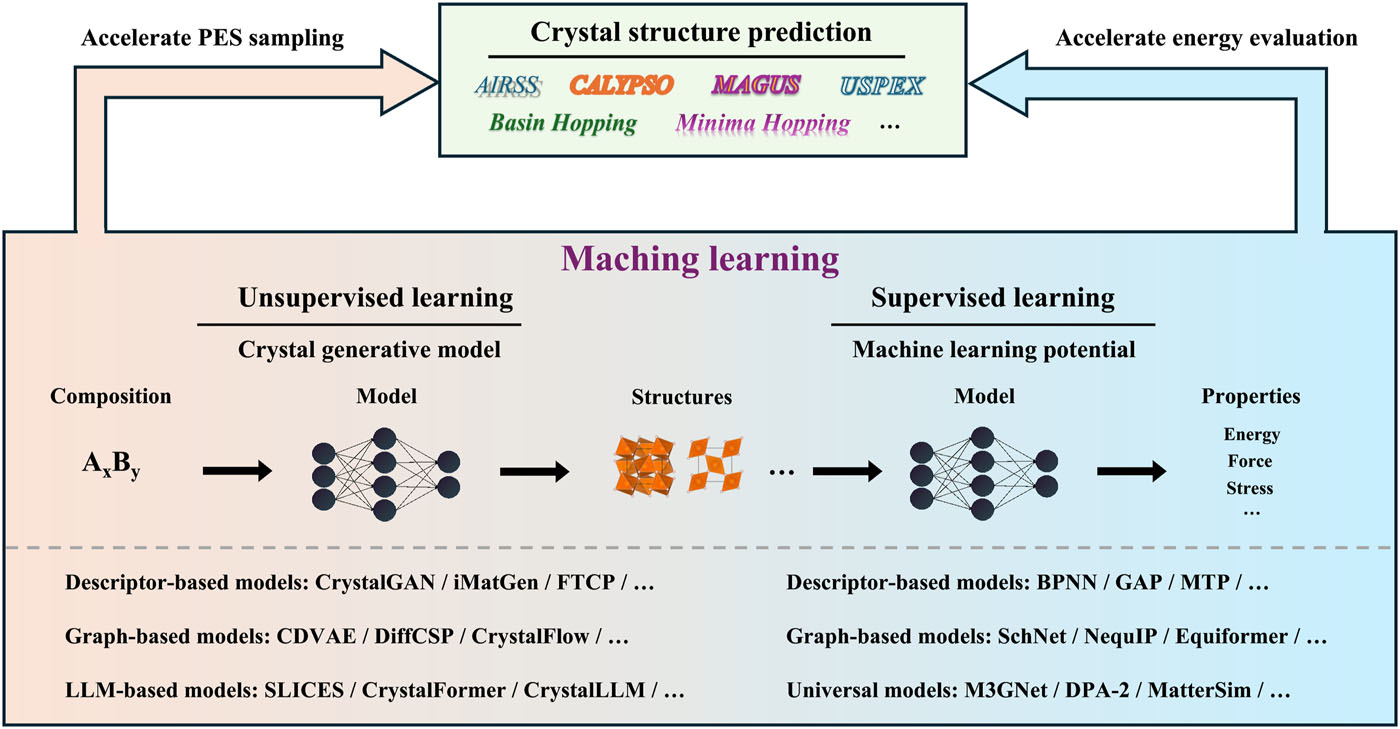
Figures(1)






 DownLoad: