| Citation: | Kline J.L., Hager J.D.. Aluminum X-ray mass-ablation rate measurements[J]. Matter and Radiation at Extremes, 2017, 2(1). doi: 10.1016/j.mre.2016.09.003

|

| [1] |
J. Lindl, Development of the indirect-drive approach to inertial confinement fusion and the target physics basis for ignition and gain, Phys. Plasmas 2 (1995) 3933–4024.10.1063/1.871025
|
| [2] |
P. Amendt, Personal Communication (2014).
|
| [3] |
R.E. Olson, G.A. Rochau, O.L. Landen, R.J. Leeper, X-ray ablation rates in inertial confinement fusion capsule materials, Phys. Plasmas 18 (2011) 032706.10.1063/1.3566009
|
| [4] |
T.R. Boehly, R.S. Craxton, T.H. Hinterman, J.H. Kelly, T.J. Kessler, et al., The upgrade to the Omega laser system, Rev. Sci. Instrum. 66 (1995) 508–510.10.1063/1.1146333
|
| [5] |
J.M. Soures, R.L. McCrory, C.P. Verdon, A. Babushkin, R.E. Bahr, et al., Direct-drive laser-fusion experiments with the OMEGA, 60-beam, >40 kJ, ultraviolet laser system, Phys. Plasmas 3 (1996) 2108–2112.10.1063/1.871662
|
| [6] |
H.N. Kornblum, R.L. Kauffman, J.A. Smith, Measurement of 0.1–3-keV X rays from laser plasmas, Rev. Sci. Instrum. 57 (1986) 2179–2181.10.1063/1.1138723
|
| [7] |
C. Sorce, J. Schein, F. Weber, K. Widmann, K. Campbell, et al., Soft X-ray power diagnostic improvements at the Omega Laser Facility, Rev. Sci. Instrum. 77 (2006) 10E518.10.1063/1.2336462
|
| [8] |
H.F. Finn, UNSPEC Reference Manual Version 10/29/82, 1982.
|
| [9] |
R.L. Kauffman, H.N. Kornblum, D.W. Phillion, C.B. Darrow, Drive characterization of indirect drive targets on the Nova laser (invited), Rev. Sci. Instrum. 66 (1995) 678–682.10.1063/1.1146258
|
| [10] |
A. Seifter, G.A. Kyrala, Different methods of reconstructing spectra from filtered X-ray diode measurements, Rev. Sci. Instrum. 79 (2008) 10F323.10.1063/1.2957935
|
| [11] |
D.L. Fehl, F. Biggs, Verification of unfold error estimates in the unfold operator code, Rev. Sci. Instrum. 68 (1997) 890–893.10.1063/1.1147713
|
| [12] |
M.J. May, K. Widmann, C. Sorce, H.S. Park, M. Schneider, et al., Uncertainty analysis technique for OMEGA Dante measurements, Rev. Sci. Instrum. 81 (2010) 10E505.10.1063/1.3475385
|
| [13] |
J. Li, X.B. Huang, S.Q. Zhang, L.B. Yang, W.P. Xie, et al., Investigation of spectra unfolded for a filtered X-ray diode array with improved smoothness, Rev. Sci. Instrum. 80 (2009) 063106.10.1063/1.3157042
|
| [14] |
R.E. Marrs, K. Widmann, G.V. Brown, R.F. Heeter, S.A. Maclaren, et al., Use of a priori spectral information in the measurement of X-ray flux with filtered diode arrays, Rev. Sci. Instrum. 86 (2015) 103511.10.1063/1.4934542
|
| [15] |
N.E. Lanier, C. Hamilton, J.M. Taccetti, A monochromatic X-ray imaging system for characterizing low-density foams, Rev. Sci. Instrum. 83 (2012) 10E521.10.1063/1.4732183
|
| [16] |
J.J. Macfarlane, I.E. Golovkin, P.R. Woodruff, HELIOS-CR A 1-D radiation-magnetohydrodynamics code with inline atomic kinetics modeling, J. Quant Spectrosc. Radiat. Transfer 99 (2006) 381–397.10.1016/j.jqsrt.2005.05.031
|
Figures(6)

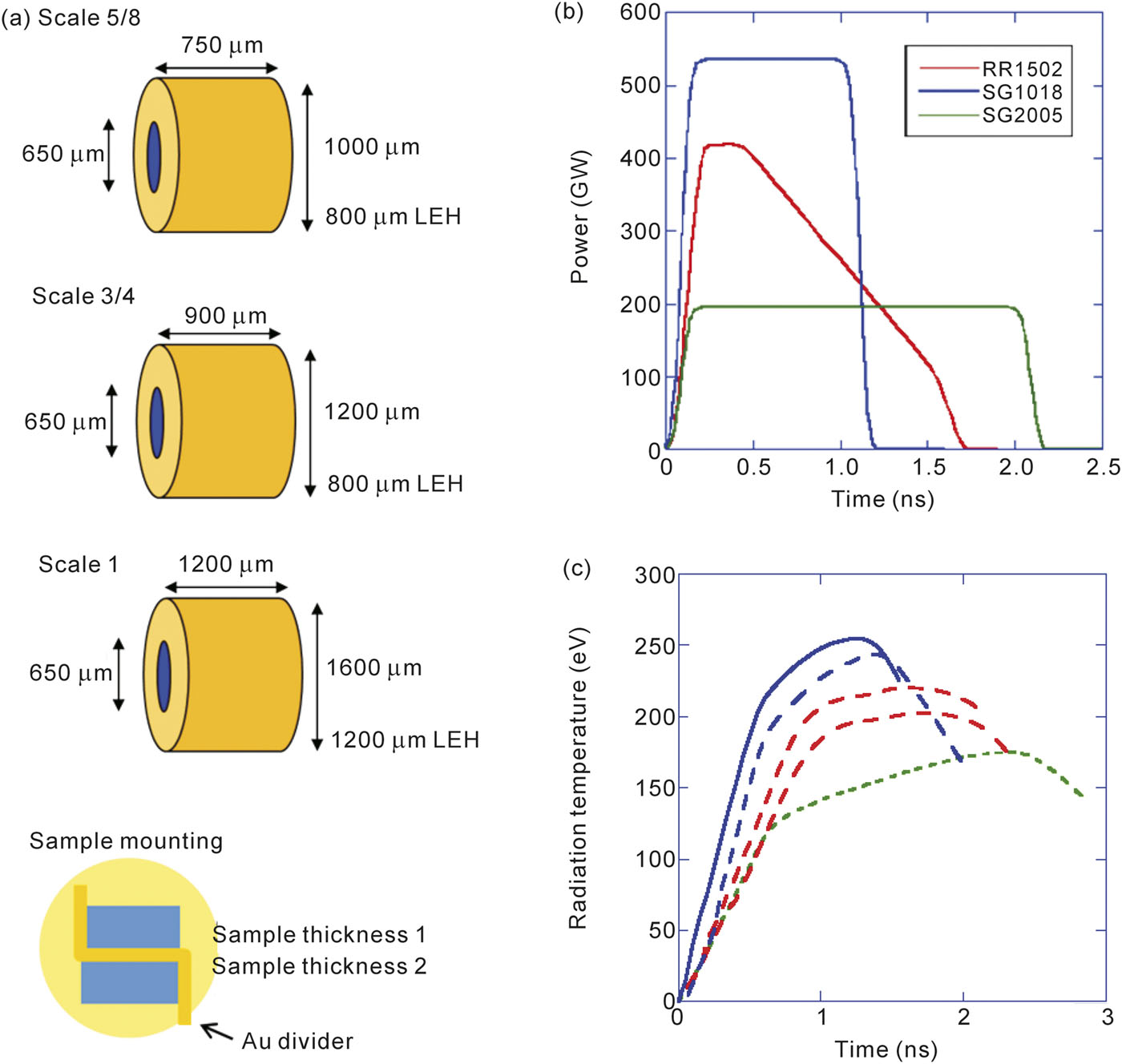
 ), 3/4 (
 ) and 1 (
 ) hohlraum scale. Note, the two
different temperature profiles for the reversed ramp with the 3/4 scale hohlraum are
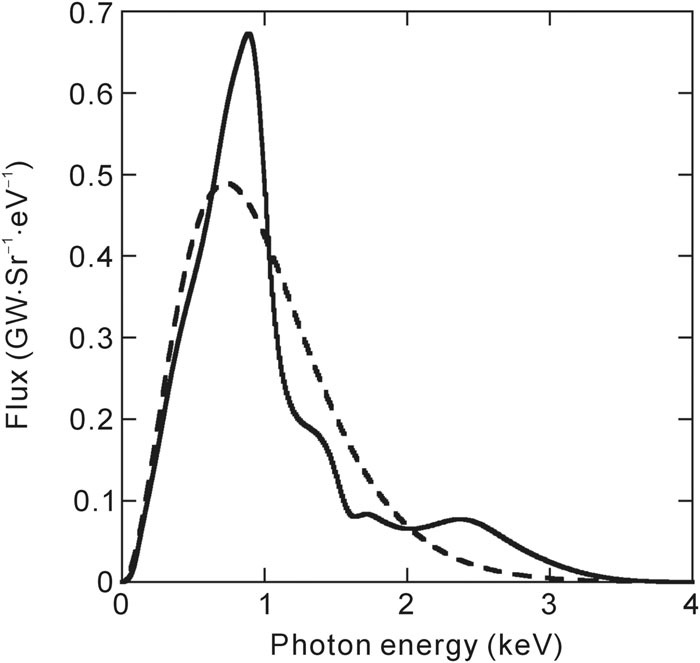
achieved by reducing the laser energy/beam from 500 J to 300 J.) with the equivalent Planckain
spectrum () for a
radiation temperature of (258 ± 6) eV for a 5/8 scale hohlraum with a 1 ns square pulse
(solid blue curve in Fig. 2).
) hohlraum scale. Note, the two
different temperature profiles for the reversed ramp with the 3/4 scale hohlraum are
achieved by reducing the laser energy/beam from 500 J to 300 J.) with the equivalent Planckain
spectrum () for a
radiation temperature of (258 ± 6) eV for a 5/8 scale hohlraum with a 1 ns square pulse
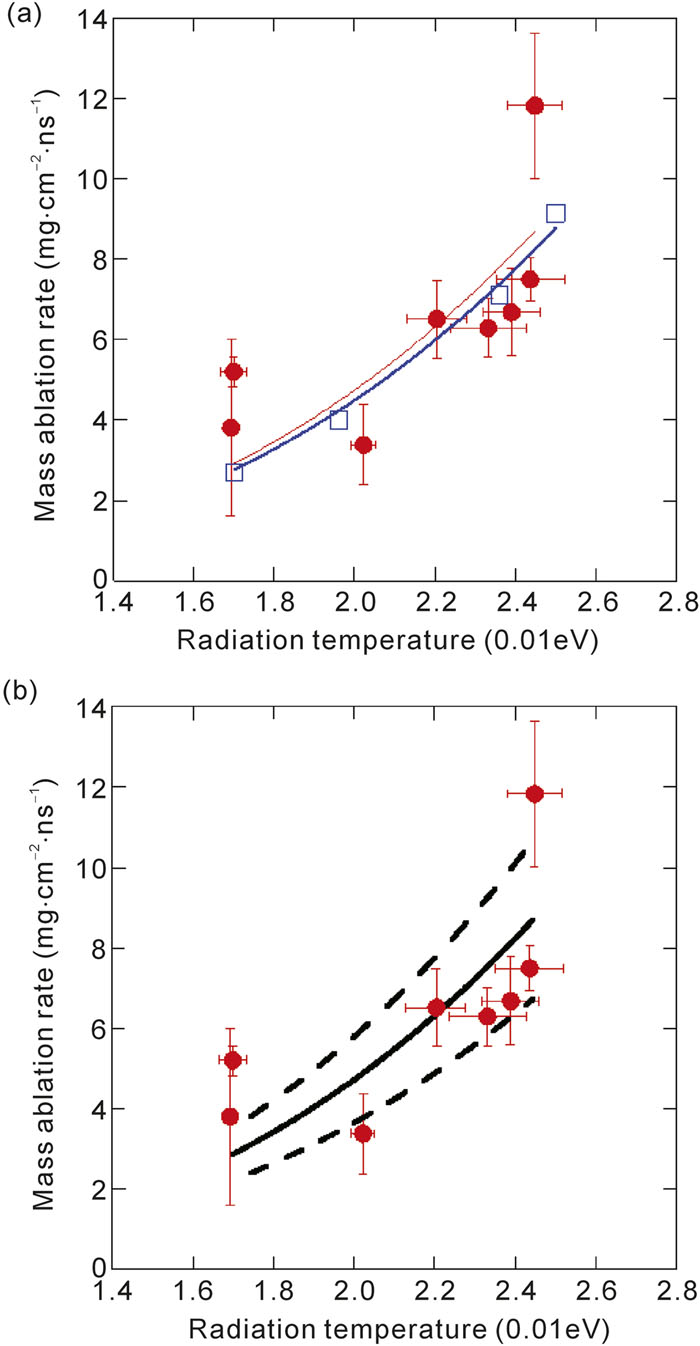
(solid blue curve in Fig. 2). ) along with the predicted
mass-ablation rate from Helios (
) along with the predicted
mass-ablation rate from Helios ( ). The solid lines represent the
fits with the measured ablation rate coefficient being (0.59 ± 0.6)
mg·cm−2·ns−1 and the predicted value being 0.56
mg·cm−2·ns−1; (b) A comparison of the measured aluminum
mass-ablation rate with the fitted data () along with the confidence
intervals for the fit ().
). The solid lines represent the
fits with the measured ablation rate coefficient being (0.59 ± 0.6)
mg·cm−2·ns−1 and the predicted value being 0.56
mg·cm−2·ns−1; (b) A comparison of the measured aluminum
mass-ablation rate with the fitted data () along with the confidence
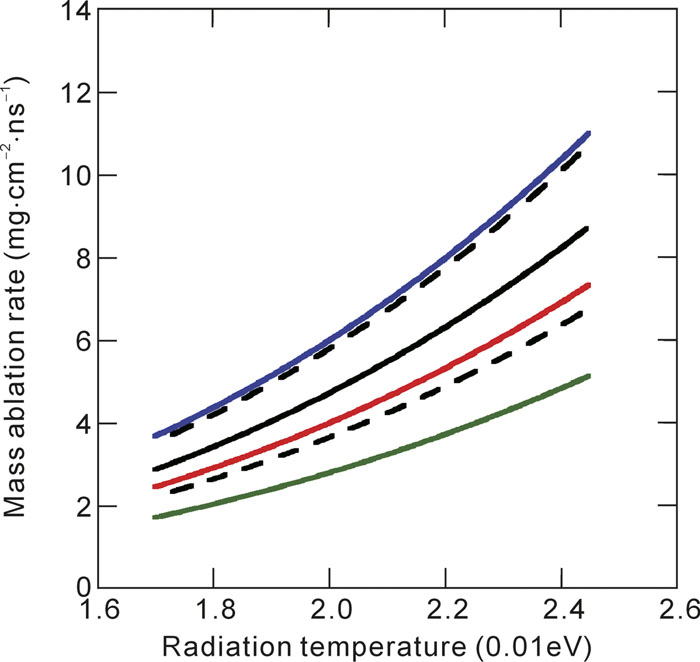
intervals for the fit (). ) along with the confidence
intervals () to
that of beryllium (
) along with the confidence
intervals () to
that of beryllium ( ), high density carbon () and Ge doped CH
(
), high density carbon () and Ge doped CH
( ).
).




 DownLoad: